
Larissa Lockshin: Clear Moon, Frost Soon
There is the immediate, sensory experience of looking at art and then there's what happens when you begin to interpret it. When you start to see yourself in it and your subjective experiences creep into your understanding.
Stepping into EUROPA NYC at the close of last month, I thought I had a grasp on Larissa Lockshin’s work. Rendered digitally, her paintings are beautiful; visited in a room, they become much more malleable. Beyond interpretation, her canvases transform right before your eyes, akin to the hypnic jerk that jolts you awake upon falling asleep.
The show ends in late September, and missing it would have left me relying on assumptions. Lockshin paints on satin, a shiny material that changes with light and perspective. Her process is both precise and fast, creating marks that feel urgent, like a fading memory. The exhibition, 'Clear Moon, Frost Soon,' feels like a visual poem meant to make you feel something.
In the gallery, I felt a trace of femininity in her work — a reminder of girlhood and the sense of wonder we try to hold onto before it fades. She uses colors and symbols that echo familiar patterns in nature.
After the exhibition, Lockshin spoke with office about the poetry in her work and the experience of painting on satin.
What is your creative process like when you start a new piece, and how do you decide on the direction it will take?
It's really just my mood. The first mark will indicate the second mark, et cetera. It's hard to explain how I know when to stop — sometimes I don't quit on time. The paintings are very easy to overwork, and I'll have to start again with a completely new piece of satin. I’ll paint for a while, not overthinking it, and then I'll step back and see where it is. Then back to the fugue state, and so on and so forth.
Your work is described as having "soft ocellated forms" and "mottled marks." Can you elaborate on the symbolism and emotions these shapes and marks represent in your pieces?
I would attribute it to the materials. I use soft pastels and oil sticks, drawing materials, so the pigment is applied directly by hand rather than with a brush. I'm applying a lot of pressure so the forms and gestures become more concentrated and urgent. The paintings don't intend to be representations of nature, but I try to capture the feeling of a hazy memory, or a fleeting glimpse.
What motivated your transition to using hand-dyed fabrics and hand-carved frames in your artwork, and how do they contribute to blurring the lines between painting and sculpture?
All of the paintings are on satin, which is so shiny that it becomes an active ground and changes in various lighting or positioning to the viewer. The negative space is important — the luster prevents the painting from being only an image. The viewer is required to move around it as they would a sculpture. Because I see them more as objects than images, I felt that the carved elements on the frames would emphasize that. The dyed fabric adds another layer of depth and variety to the work, in my opinion.
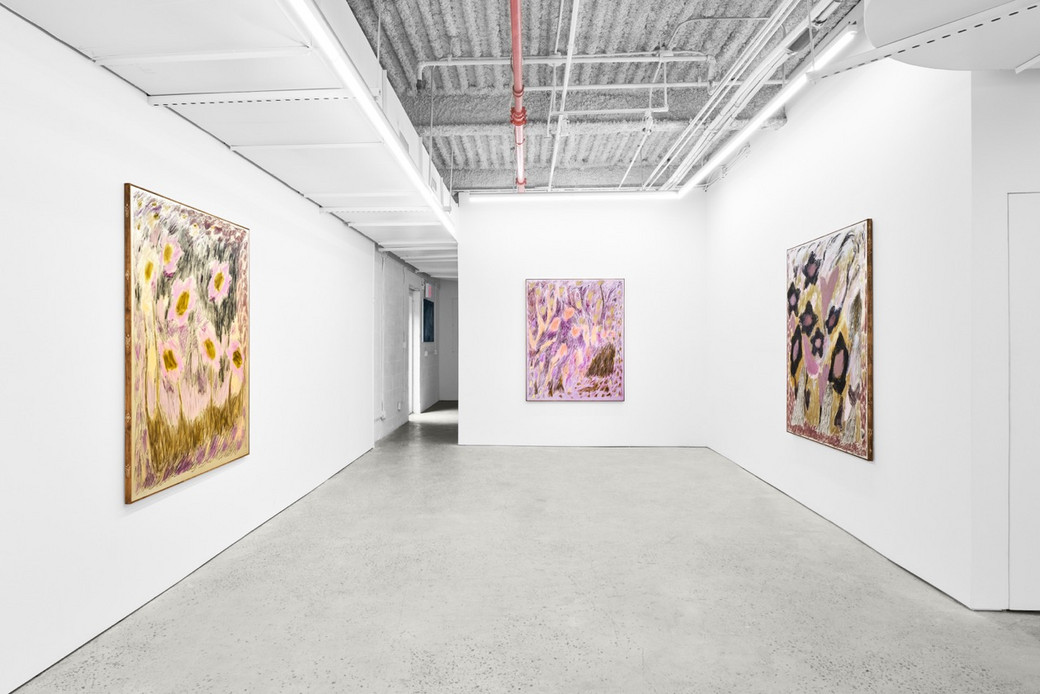
Installation view, Larissa Lockshin: Clear Moon, Frost Soon, EUROPA NYC, 2023
Your art is said to capture "various states of being." Could you elaborate on the different emotional and psychological states your art explores?
If my work should make people feel a certain emotion, it feels like a success. It's not intentional, but maybe my energy stays with the piece a little bit.
What role does the concept of being "mesmerized" play in your work, and how do you aim to transport your viewers into a state of fervor and zeal? It reminds me of creation from a child’s POV — an innocent, unsullied form of expression.
My process is not at all logical and I don't plan anything in advance. I usually paint with music playing — I listen to a lot of 90's dance playlists and Vivaldi — and I totally zone out. I think I'm trying to activate secret parts of my brain, hidden memories or emotions I haven't felt for a long time. It helps me remember that I am human. After I work for a while, I step back and try to analyze the piece — create a vague plan for its future. It never turns out the way I think it will, and that's both fun and frustrating for me.

 .
. 
