
[NoHo Arts District, CA] – This month’s LA Art blog features Cammie Staros’s Pompeii at Nazarian / Curcio, an exhibition that reframes ancient catastrophe as something unsettlingly contemporary.
At Nazarian / Curcio, Cammie Staros’s Pompeii does not simply depict disaster. It quietly reconstructs it. Named after the Roman city frozen by the eruption of Mount Vesuvius in 79 CE, the exhibition refuses to treat that event as distant history. Instead, Staros collapses time and pulls Pompeii into the present. Catastrophe here is not a singular tragedy sealed in ash. It is an ongoing condition, one we are already living inside.
You feel this immediately underfoot.
Spread across the gallery is a field of handmade ceramic tiles (thousands of them) laid out as a floor. They look solid at first, earthy and matte, like something excavated rather than fabricated. I was afraid to walk on them. Then a faint crack sounds as someone steps forward. Another follows. Should I turn back? The surface gives way slowly, unpredictably, recording each visitor’s passage as damage. Over the course of the exhibition, the floor will continue to fracture, mapping human movement as a pattern of stress and breakage.
It is strangely intimate. You become hyperaware of your own weight, of the simple act of walking. Every step is both participation and violation.

Staros has been making these tiles for more than a decade, firing them at temperatures that leave them deliberately vulnerable. The installation transforms the gallery into a living archaeological site – not one that displays ruins, but one that produces them in real time. By the end of the show, the floor will hold a collective record of everyone who crossed it, a fragile archive written through pressure rather than ink.
The timing matters. Created in the wake of recent Los Angeles wildfires, Pompeii carries the emotional residue of local disaster. The ancient city becomes less a historical reference than a mirror: a reminder that sudden destruction, once framed as exceptional, now feels cyclical, even expected. Staros doesn’t dramatize this connection. She lets the material do the talking – the brittleness of clay, the inevitability of fracture, the slow accumulation of damage that only becomes visible over time.
On the walls, a different kind of tension emerges. Staros’s new mosaic works echo the decorative surfaces of Roman villas, but their beauty is interrupted. Stone fragments are carefully assembled, then sliced through with bands of luminous resin that feel almost surgical. These cuts read as repairs, or maybe as wounds. They point to the uneasy afterlife of ancient artifacts: excavated, transported, restored, displayed and preserved, yet permanently displaced from their original context.
The mosaics are quieter than the floor, but no less unsettling. They suggest that preservation is not a neutral act. To save something is also to alter it, to pull it into a new narrative that may have little to do with its origins.
Staros has long worked with forms borrowed from Greek and Roman antiquity, but she avoids nostalgia. Her interest lies in the way classical objects carry ideologies forward—ideas about empire, permanence, beauty, control. In Pompeii, those inherited forms feel unstable, as if the past itself were shifting beneath contemporary anxieties about climate, infrastructure, and survival.
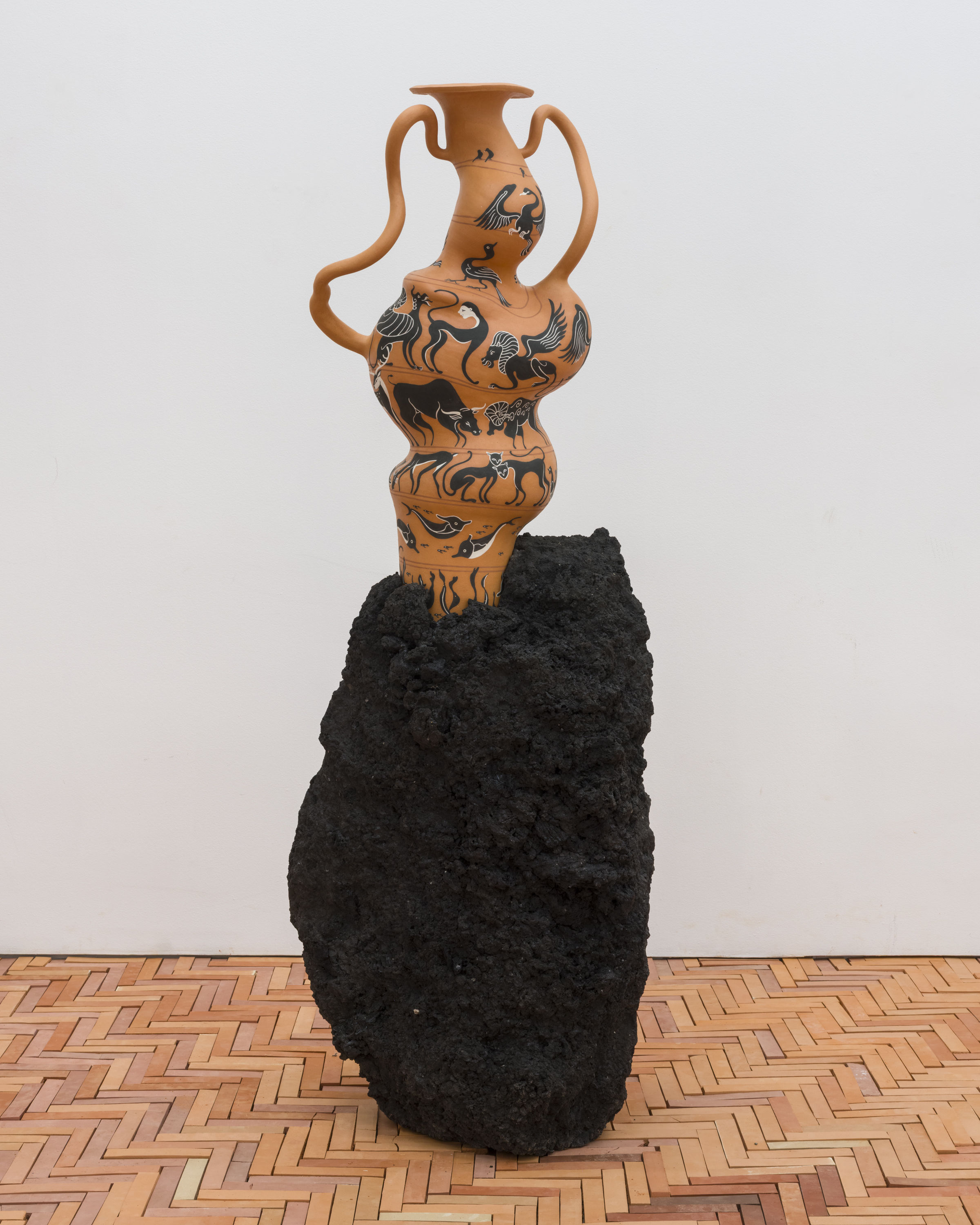
What lingers after leaving the exhibition is not a single image but a sensation: the memory of walking on something that was quietly breaking. The show resists spectacle. There is no theatrical simulation of eruption, no dramatic ruin. Instead, Staros offers a slower realization—that collapse often happens incrementally, through ordinary actions repeated over time.
By the exhibition’s end, the gallery will have become a kind of time capsule, its floor permanently altered by the presence of strangers. This is the paradox at the heart of Pompeii: destruction as a form of documentation, fragility as a method of remembering.
Staros seems to be asking a disarmingly simple question. Not how civilizations fall, but how it feels to live just before, or just after, the fall. When daily life continues even as the ground grows less certain.
It is a question that follows you out the door, long after the cracking sounds stop.
Show Information:
Runs: February 21 – March 28, 2026
Where:
Nazarian / Curcio
616 N La Brea Ave., Los Angeles, CA 90036

 .
. 
