Ken Gun Min: Strange Days of a Quiet Sun

Nazarian / Curcio is pleased to present Strange Days of a Quiet Sun, a solo exhibition of new paintings by Ken Gun Min. The exhibition marks the artist’s third solo presentation with the gallery and features a new body of paintings alongside a monumental painted folding screen.
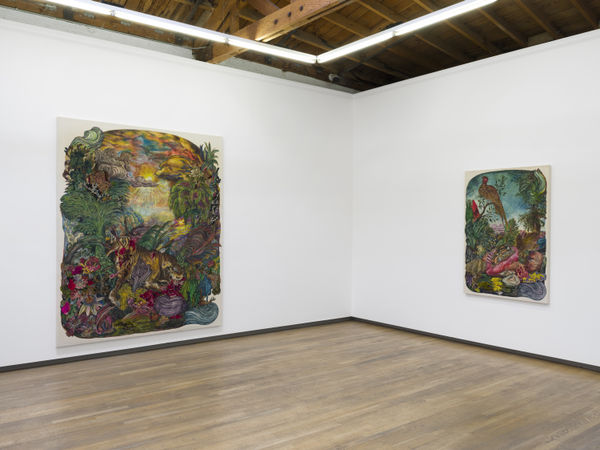
In Strange Days of a Quiet Sun, Min continues his established visual language of vibrant color, dense composition, and ornamented surfaces enriched through embroidery, beading, and hand-applied materials. Across the exhibition, lush botanical environments serve as immersive stages where figures, animals, and symbols converge. While remaining consistent with Min’s earlier work, these paintings move toward a more symbolically concentrated register, foregrounding singular motifs such as the sun, the tree, the animal, and the body as sites where historical, political, and emotional tensions are distilled.
The exhibition takes its title from a central painting and a phrase borrowed from astronomy. The “quiet sun” refers to a cyclical weakening of solar activity marked by diminished sunspot presence; Min repurposes the term as a poetic metaphor for a period of collective sadness, mourning, and estrangement—an atmosphere that feels dimmed, unsettled, and profoundly strange. In the painting, the sun appears blackened and adorned with onyx stones and black lace. Set within a vibrant, turbulent landscape, the celestial body becomes both ominous and luminous, operating as a transformational force that anchors the composition while intensifying its emotional charge.
Throughout the exhibition, Min merges references drawn from Western and Eastern art histories with imagery sourced from political illustration and propaganda. Motifs drawn from European hunting scenes and East Asian landscape traditions coexist within singular compositions, collapsing disparate visual languages into hybrid environments where aesthetic beauty and latent violence remain intertwined.
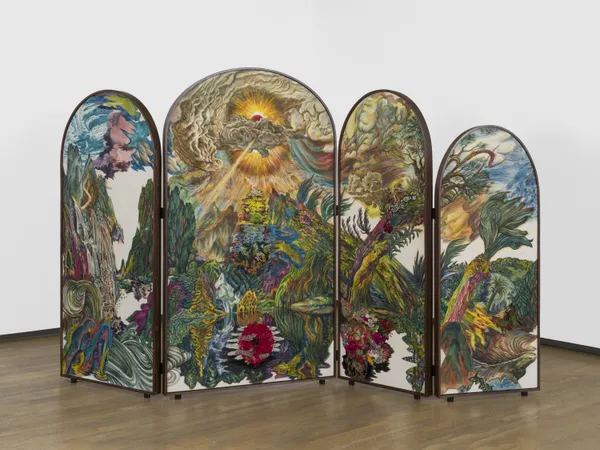
Anchoring the exhibition is a monumental, double-sided folding screen composed of eight individually hand painted, beaded, and embroidered canvases. Drawing from the tradition of painted folding screens in East Asia, particularly the Japanese byōbu and Korean byeongpung, which functioned as both architectural dividers and sites of narrative display, Min reinterprets the format through his unique language. One side unfolds as a kaleidoscopic, densely layered landscape rendered in saturated color, while the verso presents a subdued, nearly monochromatic image of a solitary tree, establishing a quiet but deliberate contrast between the two surfaces.
Animal imagery recurs across several works, often echoing the visual language of pursuit, sacrifice, and endurance. In Tiger as Saint Sebastian, a tiger appears no longer as predator, but transforms into a figure of resistance and martyrdom. Since 2019, Min has repeatedly depicted tigers as wounded and suspended figures, often referencing the Korean tiger—a motif embedded in folklore, Joseon-era painting, and nationalist imagery, historically associated with guardianship and survival. Drawing from Peter Paul Rubens’ depiction of the tiger, Min inverts the Western tradition by recasting the animal as a sanctified, suffering body. Referencing the iconography of Saint Sebastian, the tiger becomes suspended between vulnerability and resilience.
Queer narratives emerge most directly through Min’s treatment of the male body within the landscape. Nude figures appear embedded within dense foliage, their forms partially concealed by botanical excess. These compositions place the viewer in a voyeuristic position, implicating the act of looking and unsettling traditional hierarchies between subject and spectator. In one painting, a nude male figure is violently embraced by a bear, its claws drawn and blood rendered through shimmering red beads. The image oscillates between intimacy and threat, desire and danger, tenderness and brutality.
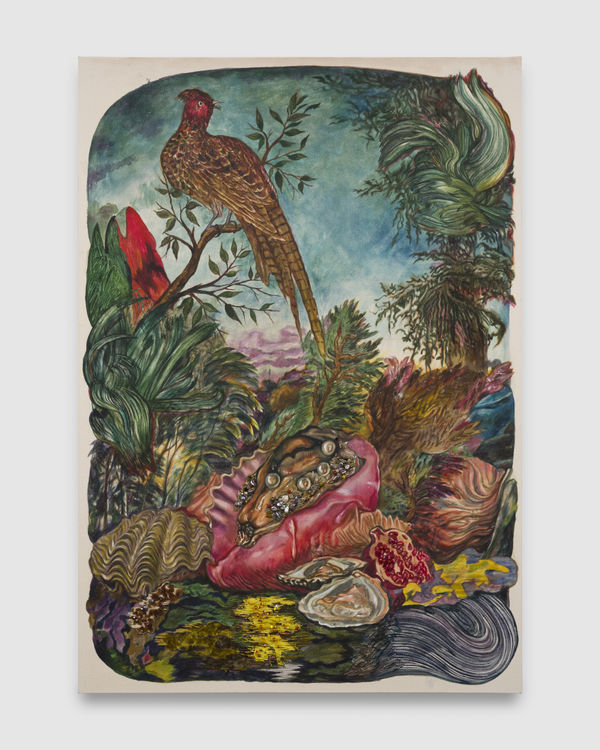
Political histories surface throughout the exhibition with restraint. Works such as Beyond the Struggle Narrative (Okinawa) gesture toward the continued presence of U.S. military bases abroad and the layered histories they produce. Okinawa’s association with pearl cultivation becomes materially significant, as several paintings incorporate baroque pearls sourced from the region. Irregular and historically undervalued, these pearls function as metaphors for growth under pressure and for alternative systems of beauty and worth.
Two new tree paintings introduce a subtle shift in Min’s visual approach. In Secret Map of Camp Garrison, Yongsan and 7 Flavors of Magic Candy Tree, embroidered and beaded trees rise against largely unpigmented canvas. The branches are composed of stitched imagery, beadwork, pigment, and hand-drawn maps Min created during visits to Camp Garrison in Seoul beginning in 1997, when the site housed a major U.S. military base. These works reflect Min’s long-standing engagement with landscapes shaped by military presence, memory, and erasure, using the tree as a vessel for accumulation and quiet testimony.
Across Strange Days of a Quiet Sun, lush botanical space operates as the exhibition’s connective framework. Flowers, foliage, animals, and ornament recur as carriers of desire, concealment, endurance, and transformation. These environments are not utopian, but charged and ambivalent—sites where pleasure and grief, intimacy and aggression, history and fantasy remain entangled. Through layered materiality and dense visual symbolism, Min continues to challenge dominant modes of representation, offering images that are as seductive as they are unsettled.
-
 Ken Gun MinStrange days of a quiet sun, 2026Baroque pearl, Onyx, crystal, assorted gemstones, vintage beads, Korean pigment, silk embroidery thread, found fabric oil on canvas
96 x 78 in
243.8 x 198.1 cm -
Ken Gun MinTiger as saint Sebastian, 2026Baroque pearl, Onyx, crystal, assorted gemstones, vintage beads, Korean pigment, silk embroidery thread, found fabric oil on canvas96 x 78 in
243.8 x 198.1 cm -
Ken Gun MinYour love is not good (Camp Casey), 2026Jade, Onyx, crystal, assorted gemstones, vintage beads, Korean pigment, silk embroidery thread, found fabric, oil on canvas84 x 67 in
213.4 x 170.2 cm -
Ken Gun MinMy love is not good, 2026Baroque pearl, Onyx, crystal, assorted gemstones, vintage beads, Korean pigment, silk embroidery thread, found fabric oil on canvas80 x 64 in
203.2 x 162.6 cm -
Ken Gun MinBeyond the struggle narrative (Okinawa), 2026Baroque pearl, Onyx, crystal, assorted gemstones, vintage beads, Korean pigment, silk embroidery thread, found fabric oil on canvas60 x 42 in
152.4 x 106.7 cm -
Ken Gun MinThe pregnant tree (Secret map of Camp Garrison, Yong San), 2026Baroque pearl, Onyx, crystal, assorted gemstones, vintage beads, Korean pigment, silk embroidery thread, found fabric oil on canvas60 x 42 in
152.4 x 106.7 cm








 .
. 
